

Quantum Encoding: Beyond Traditional Compression
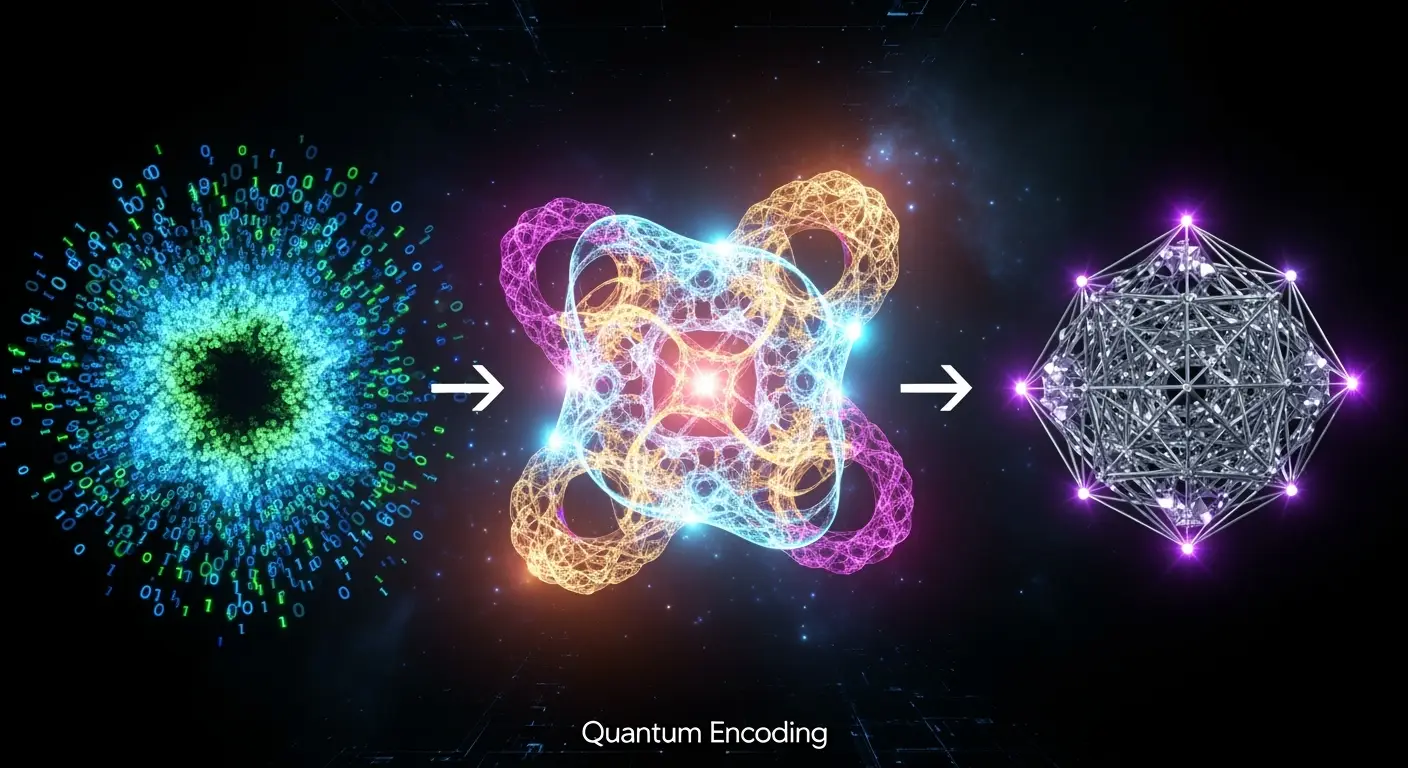
Exploring the intersection of quantum mechanics and information theory. How principles from quantum mechanics, topology, fractal geometry, and harmonic resonance create fundamentally new ways to represent and compress information.
In an age defined by an explosion of data driven by AI, IoT, and increasingly complex simulations, the need for efficient data compression is more critical than ever. Traditional compression techniques, while powerful, often operate at the bit level, focusing on statistical redundancy to reduce file sizes.
Think of familiar methods like ZIP, GZIP, or JPEG: they are highly effective at packing more data into less space by finding repetitive sequences or exploiting perceptual limitations.
However, as data becomes more complex, representing high-dimensional spaces, intricate structures, or dynamic relationships, traditional compression can hit inherent limitations. These methods often overlook or even compromise the underlying meaning or structure of the data in exchange for maximizing bit reduction. We believe that truly revolutionizing how we handle information requires a paradigm shift: Quantum Encoding, an approach that transcends the focus on mere bit reduction to explore data representation rooted in fundamental principles of physics and mathematics.
A New Paradigm in Information Representation
Quantum Encoding, as we define it, is a high-level research initiative exploring how principles inspired by quantum mechanics, advanced topology, fractal geometry, and harmonic resonance can create fundamentally new ways to represent, compress, and process information.
The core idea is to move beyond viewing data simply as sequences of bits. Instead, we are exploring how data can be understood and encoded as:
Topological Structures
Treating data not as points in a grid, but as shapes, forms, and interconnected relationships. Topological Data Analysis (TDA) allows us to extract fundamental structural invariants, features like loops, voids, and connected components, that define a dataset's shape at various scales. Encoding data based on these inherent topological features ensures that the fundamental structure and meaning are preserved, even under high-density compression.
Fractal Patterns
Many complex natural and generated datasets exhibit self-similarity across different scales. By identifying these fractal patterns using techniques we're developing (such as NDimensionalTransformer algorithms), we can create highly efficient mapping functions that represent vast amounts of data with a minimal set of recursive rules. This is akin to describing a complex shape not by listing every point, but by providing the simple generative rules that create its fractal structure.
Resonant Harmonics
Everything vibrates, including information itself. We are investigating how principles of harmonic resonance and specific frequencies (like the golden ratio φ and 147Hz, which appear to influence system stability and coherence) can be used to represent and synchronize data. Encoding information onto resonant wave patterns may allow for new forms of data validation, integrity checking, and even associative processing based on harmonic relationships.
Quantum-Inspired Principles
While not physical quantum computing (at this stage), our algorithms draw inspiration from quantum mechanics. Concepts like superposition are explored in representing multiple potential data states simultaneously, while ideas related to entanglement and observer effects inform how data integrity is linked across distributed systems and how the act of analysis itself might be monitored or influence outcomes (as explored in projects like Mirror Guard).
These interdisciplinary principles converge in frameworks like Topological Enhanced Lossless Feature Fusion (T-ELFF). T-ELFF aims to develop compression algorithms that don't just reduce bits but fuse features based on their topological and fractal properties, preserving structural integrity losslessly while achieving ultra-high compression ratios.
Why This Research Matters
This research into Quantum Encoding offers the potential for revolutionary advancements:
- Ultra-High Efficiency: Leveraging structural and relational encoding techniques can potentially achieve compression levels far beyond traditional methods for complex datasets.
- Structural Integrity & Meaning Preservation: By focusing on topological invariants and fractal patterns, the encoding preserves the fundamental shape and meaning of the data, which is crucial for downstream analysis and processing.
- New Forms of Data Processing: Encoding data onto resonant or topological structures could enable novel forms of computation and analysis directly on compressed data.
- Addressing the Data Deluge: New, more efficient methods are essential for managing, storing, and transmitting the ever-increasing volume and complexity of information in disciplines ranging from scientific research to AI training.
Example Implementation
Here's a simplified code example showing a conceptual implementation of our topological approach:
// Simplified pseudocode for topological data encoding
function encodeTopologicalStructure(data, dimensionality = 3) {
  // 1. Create a distance matrix between data points
  const distanceMatrix = computePairwiseDistances(data);

  // 2. Generate a filtration of simplicial complexes
  const complexes = generateVietorisRipsFiltration(distanceMatrix);

  // 3. Extract persistent homology features
  const persistenceDiagrams = computePersistentHomology(complexes, dimensionality);

  // 4. Encode the most significant topological features
  const encodedRepresentation = extractPersistentFeatures(persistenceDiagrams);

  // 5. Apply compression to the sparse representation
  return compressTopologicalFeatures(encodedRepresentation);
}
Conclusion
Quantum Encoding represents a bold step beyond traditional data compression. By investigating the intersections of physics, mathematics, and information theory, we are exploring novel ways to represent and process data based on fundamental principles of structure, resonance, and complexity. This research aims to unlock new levels of efficiency and insight, paving the way for a future where information is not just stored, but understood and interacted with in entirely new dimensions. Join us as we explore these new frontiers in computational research.