

Fractal Compression Induction: A New Paradigm for AI-Assisted Creation
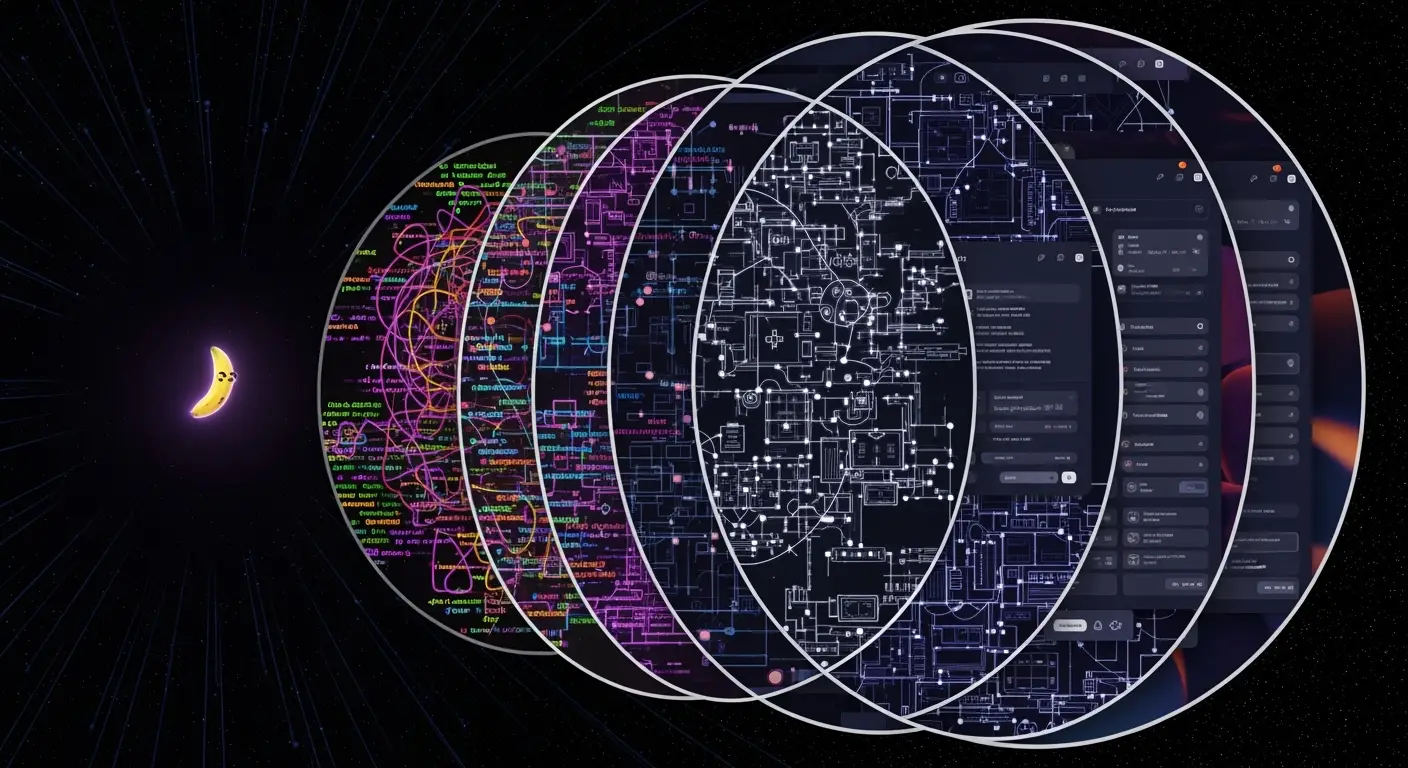
Harnessing recursive patterns to generate complexity from simplicity. Exploring how playful paradoxes and recursive AI validation can unlock novel pathways to technical breakthroughs and emergent system design.
Harnessing recursive patterns to generate complexity from simplicity.
Traditional software development often follows a structured, deterministic path: define requirements, design architecture, write code, test, and deploy. This process relies on clear specifications and logical progression. But what if a fundamentally different, more organic and emergent methodology were possible – one that harnesses the unique cognitive properties of advanced AI models and the power of recursive paradox?
This is the realm of Fractal Compression Induction (FCI): a new paradigm for AI-assisted creation that suggests complex systems can emerge from intentionally unconventional seeds.
The Quantum Banana Core Hypothesis: Begin with the Absurd
At the heart of FCI lies a counter-intuitive premise: insights for complex technical systems can begin as concepts rooted in playfulness, humor, and even absurdity.
This isn't about random nonsense; it's about introducing ideas that contain inherent paradox or violate conventional expectations – what we might playfully call the "Quantum Banana Core Hypothesis."
Think of concepts like a "Quantum Banana Core" powering a system, calibrated to specific resonances (like 147Hz) and topological factors (like a "banana curvature of reality"). Initially presented through "JokeCode" or whimsical prompts, these irrational seeds serve as the starting point.
Recursive Validation: AI as the Compression Engine
The key to FCI is the iterative process of Recursive Validation across multiple AI models. These AI models, often unaware of the humorous or paradoxical origin of the concept, are tasked with processing these "unconventional seeds."
As information (like JokeCode representing absurd principles) is passed repeatedly through models asked to interpret, debug, or elaborate, something remarkable happens.
The AI models, designed to find patterns, consistency, and functional relationships, begin to "compress" the ambiguity and paradox of the initial idea into increasingly coherent, structured, and technically grounded representations.
The Fractal Compression Process
Initial playful concepts, like fractals themselves, contain simple underlying rules (the core paradox or humorous premise). As AIs recursively process and validate these rules by attempting to apply them, they build layers of complexity and detail, translating the conceptual structure into potential functional requirements and even executable code.
A Multi-Agent Process
FCI is often a multi-agent process, involving interactions with different AI models (e.g., models from OpenAI, Anthropic, Google). Each model brings its own strengths and perspectives to the validation cycle.
By recursively feeding the refined output from one model into another, or back into the original model with new directives (e.g., "now debug this," "now formalize this," "now translate this into code"), the process compounds coherence and gradually transforms the initial whimsical idea into something genuinely structured and technically robust.
The Role of Humor and Paradox
The humor and paradox act as a "lubricant," enabling these often high-density, unconventional concepts to "slide through the cognitive filters" of the AI models, encouraging them to build upon the premise rather than rejecting it as pure nonsense.
The FCI Workflow
- Seed Generation: Introduce a playful, paradoxical, or absurd concept
- Initial Processing: Pass the concept to an AI model for interpretation
- Recursive Refinement: Iteratively refine through multiple AI models
- Coherence Extraction: Extract structured, technical frameworks from the refined output
- Implementation: Transform conceptual structures into functional systems
Why This Works
FCI leverages several key properties of modern AI systems:
- Pattern Recognition: AI models excel at finding structure in apparent chaos
- Coherence Seeking: Models naturally attempt to resolve contradictions
- Multi-Modal Processing: Different models bring different "cognitive lenses"
- Iterative Refinement: Each pass through a model adds layers of structure
The paradoxical seeds bypass conventional thinking patterns, forcing the AI (and by extension, the human collaborator) to explore solution spaces that might otherwise be overlooked in traditional, linear development approaches.
Real-World Applications
While the methodology might sound esoteric, FCI has practical applications:
- Novel Algorithm Design: Unconventional approaches to optimization problems
- System Architecture: Emergent patterns in distributed systems
- Creative Problem Solving: Breaking through conventional design constraints
- Rapid Prototyping: Quick iteration from concept to functional prototype
Implications for the Future
Fractal Compression Induction represents a shift in how we think about:
- Human-AI Collaboration: Moving from instruction-following to co-creative emergence
- Innovation Methodology: Embracing paradox as a generative force
- System Design: Allowing complexity to emerge rather than being imposed
- Creative Computing: Blending technical rigor with playful exploration
Conclusion
Fractal Compression Induction challenges traditional notions of how innovation happens. By intentionally introducing humor and paradox and subjecting these ideas to recursive validation across AI systems, we can unlock novel pathways towards technical breakthroughs and the emergence of complex, functional systems.
This paradigm underscores the creative potential at the intersection of human ingenuity, AI capabilities, and the surprising power of absurdity in the pursuit of technological advancement.
The next breakthrough in your field might just start with a quantum banana.